
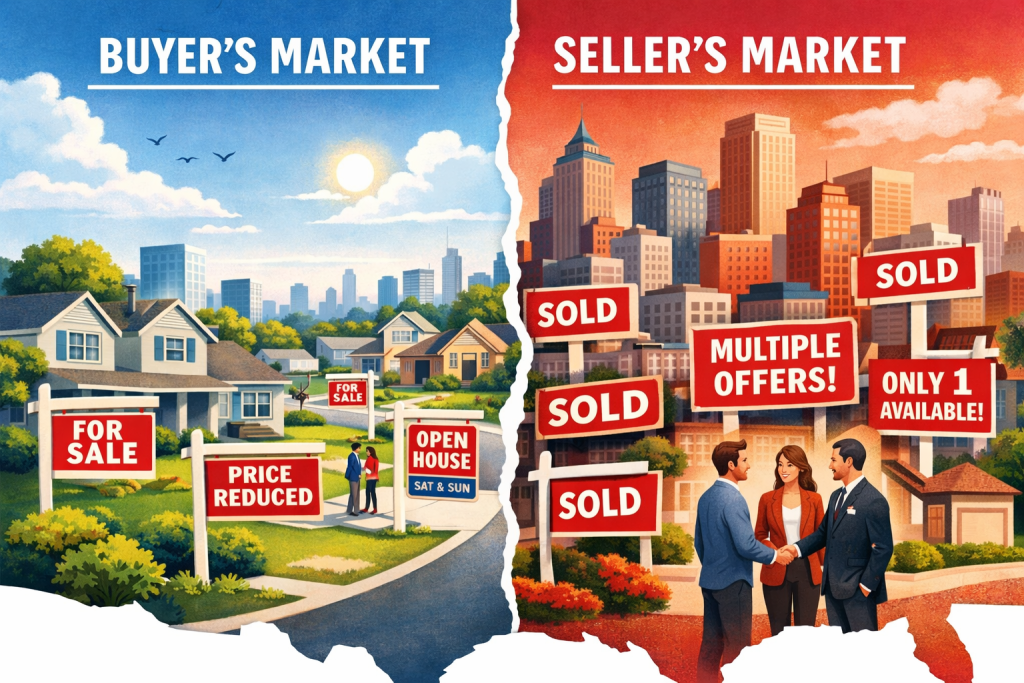
The U.S. housing market in early 2026 looks less like one national story and more like a patchwork of local market conditions. In some places, buyers are seeing more listings, longer days on market, and price cuts. In others, sellers still control the pace because supply remains tight and demand is steady. For homeowners, house hunters, and real estate professionals, the most useful question is no longer “Is it a buyer’s or seller’s market?” but “Which market, in which city, and for which price range?”
The big takeaway: national headlines can be misleading. Local inventory, job growth, insurance costs, taxes, and new construction are creating very different conditions from one metro to the next.
The big picture: why the 2026 market is uneven
Early 2026 housing conditions are being shaped by a few powerful forces at the same time. Mortgage rates remain a major affordability hurdle. Homeowners with ultra-low pandemic-era rates are still reluctant to sell. At the same time, many markets have seen enough new construction or slower demand to give buyers more negotiating room than they had in 2021 and 2022.
That is why some places are cooling into buyer-friendly territory while others remain stubbornly tight. A city can also be split by neighborhood and price band: starter homes may attract bidding wars, while higher-priced properties sit longer. In short, local market analysis matters more than ever.
Where buyers have the upper hand in early 2026
Buyer’s markets usually show up where supply is rising faster than demand, affordability is strained, or recent migration has slowed. In these areas, sellers are more likely to offer concessions, accept contingencies, or reduce asking prices after a few weeks on market.
States and metros that are often buyer-leaning
- Florida: In several markets, including Jacksonville, Tampa, Orlando, Cape Coral, Fort Myers, and Sarasota, inventory growth and high carrying costs are giving buyers more leverage.
- Texas: Austin, San Antonio, and some parts of Dallas-Fort Worth have seen more balanced or buyer-friendly conditions as supply has expanded.
- Arizona: Phoenix and surrounding suburbs have often been more negotiable than they were at the height of the boom.
- Nevada: Las Vegas and Henderson can tilt buyer-friendly when listings rise faster than demand.
- Colorado: Denver and some Front Range submarkets have had pockets of softer pricing and longer marketing times.
- Parts of California: Some inland and exurban areas are more negotiable than coastal luxury markets, especially where insurance and affordability are pressuring demand.
Why are these markets more buyer-friendly? A few recurring reasons stand out:
- More new construction: Builders can add inventory faster than existing homeowners can.
- Insurance pressure: In some Sun Belt states, rising homeowners insurance and HOA costs are weighing on affordability.
- Affordability fatigue: After years of price gains, many buyers are simply tapped out.
- Slower in-migration: Some pandemic-era destination markets have normalized.
- More price reductions: Homes that were initially overpriced are having to meet the market.
Where sellers still hold the advantage
Sellers remain in charge where supply is limited, wages are strong, and housing demand is relatively inelastic. That often happens in dense job centers, commuter hubs, and long-constrained neighborhoods where new construction is difficult.
States and metros that are often seller-leaning
- Massachusetts: Boston, Cambridge, Somerville, and many inner suburbs continue to benefit from tight supply and strong demand.
- New Jersey: Jersey City, Hoboken, and transit-accessible North Jersey towns often remain competitive because of commuter demand and limited inventory.
- Connecticut: Fairfield County and other desirable commuter markets can still favor sellers, especially for well-located homes.
- Virginia: Northern Virginia, including Arlington, Alexandria, and Fairfax County, remains structurally supply-constrained.
- North Carolina: Raleigh, Cary, and parts of Charlotte often stay competitive thanks to job growth and steady in-migration.
- New York: In many submarkets, especially well-located and well-priced properties, seller leverage remains strong.
What keeps these markets tight?
- Limited land and zoning constraints: Dense markets can’t expand quickly.
- Strong employment bases: Government, finance, healthcare, tech, and education support demand.
- Persistent commuter demand: Proximity to major job centers matters.
- Lower resale inventory: Fewer homeowners are listing, which keeps competition alive.
- Quality-of-life premiums: Good schools, transit access, and walkability still command a premium.
The middle ground: many markets are simply balanced
Not every city fits neatly into a buyer’s or seller’s market. A large share of the country is in a more balanced zone, where neither side has full control. In those markets, the outcome often depends on the property itself: condition, pricing, location, and timing.
Examples of more balanced conditions can often be found in parts of the Midwest and Southeast, where the market may look competitive for well-priced starter homes but softer for larger or less updated properties. That’s why a home one mile away can sell in a week while another sits for 60 days.
Why local markets vary so much
The biggest reason for the variation is simple: housing is local. But several factors help explain why one area is hot while another cools.
- Inventory levels: If new listings don’t keep up with demand, sellers gain power.
- Mortgage rates and affordability: Higher borrowing costs reduce the number of qualified buyers.
- Insurance and property taxes: These can materially change monthly payments and buyer behavior.
- Job growth: Markets with strong hiring tend to absorb more homes.
- Migration patterns: Areas that benefited from pandemic relocations may now be normalizing.
- Seasonality: Spring often feels hotter than winter, but local cycles vary.
- New construction vs. resale supply: Builders can add pressure to resale sellers when inventory rises.
For homeowners, that means a strong statewide headline is not enough. A seller in a high-demand school district can still get multiple offers while another seller across town must discount to attract attention. Buyers should also remember that “buyer’s market” does not mean “cheap” — it simply means more negotiating power.
What this means if you are buying or selling
If you are buying: Focus on months of supply, price reductions, and time on market in your target neighborhood. In buyer-leaning areas, ask for closing cost help, repairs, or rate buydowns. In seller-leaning areas, be ready to move quickly and write a clean offer.
If you are selling: Price to the market, not to last year’s peak. The best strategy in a softer market is often the most practical one: strong presentation, accurate pricing, and realistic expectations. In a tight market, make sure your home shows well and leverage the competition among buyers.
Key takeaways
- The 2026 housing market is local, not national.
- Buyer-leaning markets are showing up in parts of Florida, Texas, Arizona, Nevada, Colorado, and selected California submarkets.
- Seller-leaning markets remain common in places like Massachusetts, New Jersey, Connecticut, Northern Virginia, New York, and parts of North Carolina.
- Inventory, affordability, insurance, taxes, and job growth are the main reasons markets differ so widely.
- The same city can have both buyer and seller conditions depending on neighborhood and price point.
FAQ
How do I know if my local market is a buyer’s market?
Look for rising inventory, longer days on market, more price reductions, and sellers offering concessions. If homes are sitting and buyers have choices, the leverage usually shifts toward buyers.
Can a state be both a buyer’s market and a seller’s market?
Yes. In fact, that is common. A state may have buyer-leaning conditions in one metro and seller-leaning conditions in another. Even within one city, some neighborhoods can be hot while others cool off.
Are higher mortgage rates the only reason markets are cooling?
No. Rates matter, but insurance costs, property taxes, job changes, migration patterns, and new construction all influence supply and demand. In some places, insurance and HOA costs are just as important as mortgage rates.
Should I wait for a better market before buying or selling?
Not always. The “right” market depends on your personal timing, equity, financing, and housing needs. A good local strategy often matters more than waiting for the perfect national headline.
Final word: know your local numbers
In a mixed market like early 2026, the smartest move is to think locally and act strategically. Buyers should compare asking prices to recent closed sales. Sellers should study how quickly similar homes are moving and whether concessions are becoming common. Real estate still rewards people who understand their specific market, not just the national mood.
Like this article?
Please share it. Also, register to follow Vohme and receive the latest articles once a week. Vohme – Simply prctical.